Principles
How Japan Decorates for a Christmas It Doesn't Technically Have
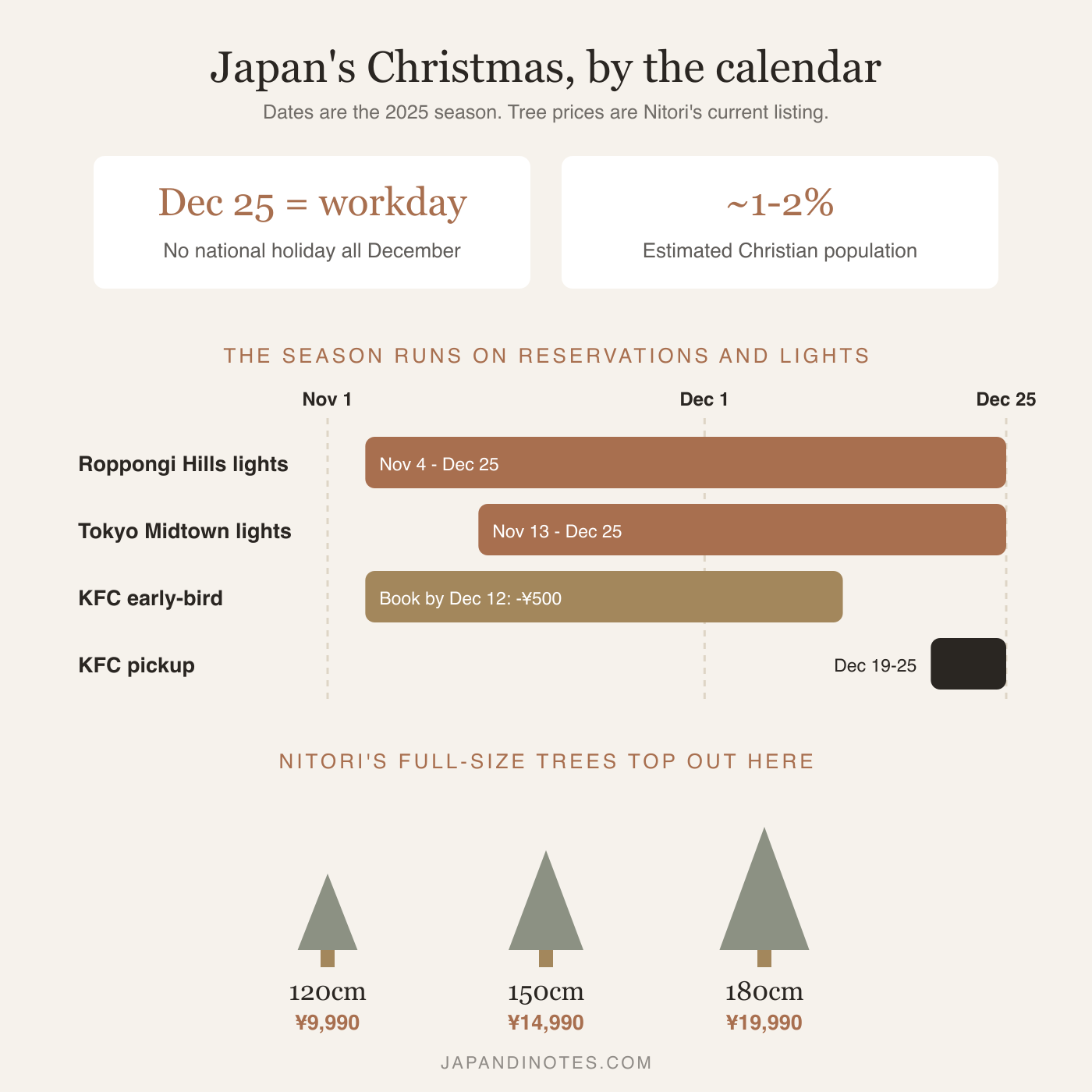
December 25th is not a holiday in Japan. It never has been. There’s no day off, no bank closure, no school break tied to it — 2026 is a normal Thursday and Friday like any other, and the only reason December feels different at all is that it’s the one calendar month with zero national holidays in it. Add in a Christian population generally estimated at somewhere around 1–2%, and you’d expect Christmas here to be a non-event. It is almost the opposite. By the first week of November, train station plazas, department store façades, and entire tree-lined boulevards are already strung with lights for a holiday most of the country has no religious stake in at all.
The short answer: Japan’s Christmas is a secular, commercial, mostly public-facing event rather than a household or religious one. The big spending happens outdoors, on illumination displays that start absurdly early and run straight through December 25th. What happens inside an actual home is much smaller — a tabletop tree if there’s a tree at all — and the two traditions that matter more than any ornament are a reservation-only bucket of fried chicken and a slice of strawberry sponge cake. None of it requires a living room the size of a showroom to copy.
Why a country with almost no Christians goes this big
The commercial version of Christmas has been around in Japan for over a century. The story most often told traces it to Meiji-ya, a Ginza import grocer that put up a public Christmas tree in its storefront sometime around the turn of the 20th century — sources disagree on the exact year, somewhere between 1900 and 1904, but they agree it drew crowds, and that other department stores in the district started copying the display within a few years. From there it stayed a store-window and café phenomenon for decades: by the early Showa era, cafés in Ginza, Shibuya, and Asakusa were running Christmas menus and dressing staff for the season, long before most households had any version of it at home.
What never arrived was the religious framing. Christmas in Japan grew up almost entirely inside department stores and advertising, which is also why it reads today as romantic and commercial rather than devotional — closer to how a lot of the English-speaking world treats Valentine’s Day than how it treats Christmas itself.
The decorations are mostly outside, and they start early
If you’re picturing string lights on a suburban roofline, that’s not really the Japanese version. Illumination here is a civic and commercial event first. Office towers, shopping streets, and park promenades run large-scale light displays that open in early-to-mid November and run nightly through December 25th, then usually stop cold the next morning. Last year, Roppongi Hills’ well-known Keyakizaka display ran November 4th through December 25th, lit from 5pm to 11pm; Tokyo Midtown’s version started November 13th on the same calendar logic. These aren’t understated — they’re built to be destinations, with crowds, photo spots, and sometimes a small Christmas market attached.
Home exteriors don’t really participate in this. Most Japanese households live in apartments without a yard or roofline to decorate, so the elaborate outdoor lighting culture that’s normal in a lot of detached-house countries just doesn’t have anywhere to go. The illumination budget gets spent by cities and corporations instead of individual homeowners, which is a very different allocation than “everyone strings their own lights,” but it means the lights you actually see are bigger and more concentrated, not absent.
What goes up inside an actual home
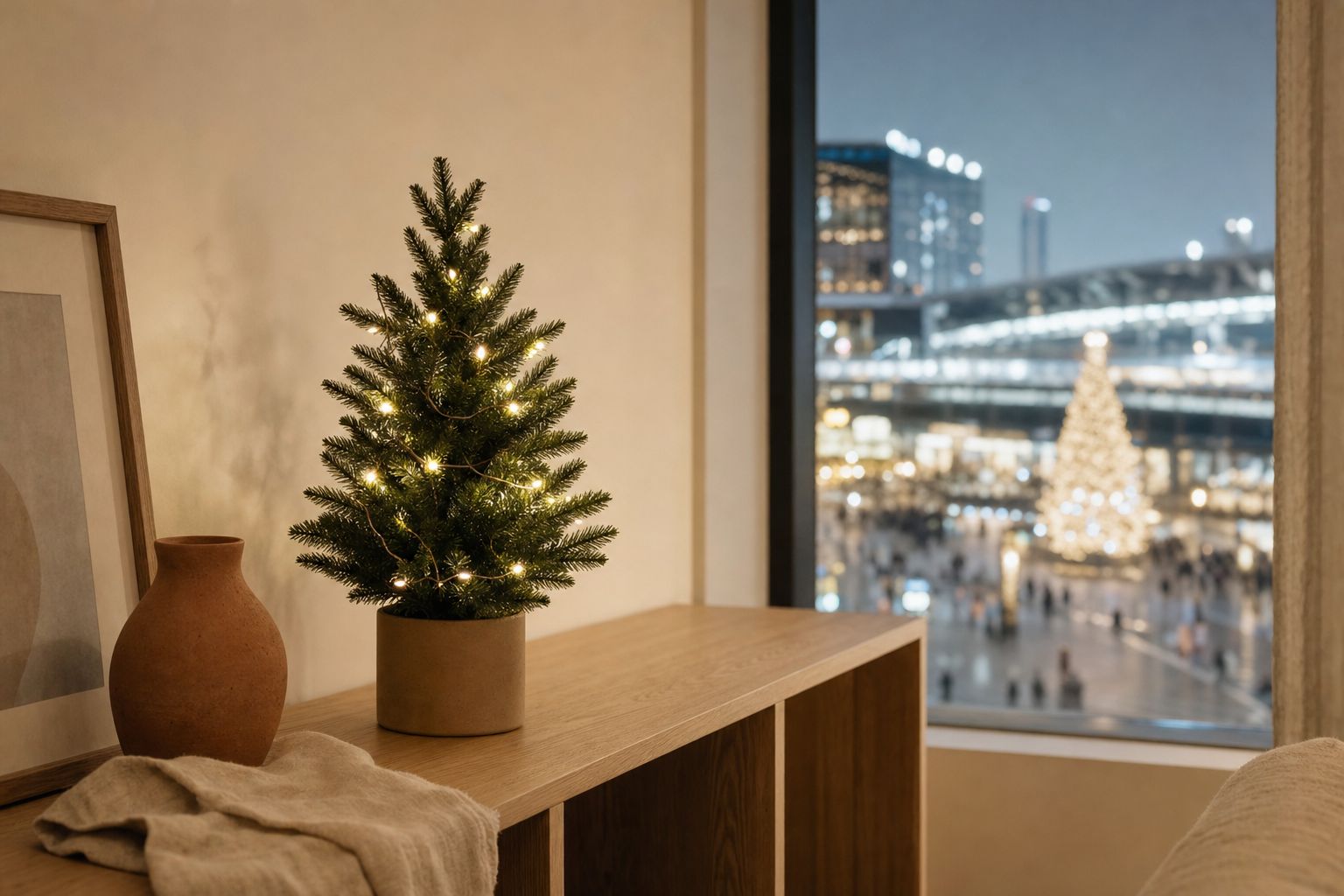
Scaled down to apartment size, that’s a small tree — if there’s a tree at all. Big retailers sell full-size options: Nitori’s current lineup runs a 120cm tree at ¥9,990, a 150cm at ¥14,990, and a 180cm at ¥19,990, which gives you a sense of where “full-size” tops out for a store built around apartment-scale furniture rather than detached houses. Plenty of households skip that entirely and go with something that fits on a shelf or a side table instead — budget chains like 3COINS have sold tabletop trees well under a thousand yen in past seasons, small enough to put away in a drawer come January 1st. The same space math that governs a rental apartment generally applies here: a two-meter tree is a genuine commitment in a room where the living room already has to do several jobs at once, so a lot of homes decide the smaller version isn’t a compromise, it’s just the correct size for the room.
One opinion, since nobody selling the big trees will say it: the oversized version usually looks worse in a small Japanese living room than the tabletop one does. A six-foot tree in a room that’s also your dining area and your bedroom’s extension reads as clutter the other eleven months you have to work around it in storage. A single lit shelf reads as intentional.
The part that actually matters more than the tree
Two things carry more cultural weight here than any ornament, and neither one is a decoration.
The first is KFC. Japan’s “Kentucky for Christmas” ad campaign ran nationally starting in 1974, and it’s the reason fried chicken — not turkey, not ham — became the default Christmas dinner for a huge number of households. The origin story gets told a few different ways depending on the source: KFC’s own version credits a foreign customer who couldn’t find turkey and made do with fried chicken at a Tokyo outlet; several other accounts credit an early store manager (most commonly named as Takeshi Okawara, though the spelling varies between retellings) with building a “party barrel” around the same idea just months after the first Japanese KFC opened in 1970. Which version is more accurate is genuinely disputed. What isn’t disputed is that the 1974 national campaign stuck, and that it turned a fast-food order into something you have to plan for: last year, reservations opened November 4th, an early-bird discount of ¥500 applied to orders placed by December 12th, and pickup ran December 19th through 25th for a Party Barrel priced around ¥4,990. Walk into a KFC in Tokyo on December 24th without a reservation and you’ll see exactly what that planning window is protecting against.
The second is cake — specifically a sponge cake topped with whipped cream and fresh strawberries, red and white against each other. The confectioner Fujiya is usually credited with adapting the recipe after a trip abroad in the early 1920s, swapping a denser imported style for a lighter sponge base, and the strawberry-shortcake version became the standard Christmas cake once it was within reach of an ordinary household budget in the 1950s. One popular explanation ties the red-and-white color scheme to the national flag, though that’s offered more often as a nice story than as settled history. Convenience stores take preorders for these cakes weeks in advance, the same way they do for the December chicken, which tells you something about how far in advance a Japanese December gets planned around food you have to order ahead rather than just buy on the day.
Where I’m honestly still filling this in
I live in a Tokyo apartment, so I see the illumination the way most people here do — on the walk to the station, outside the office, in the window of whatever café I’m in that week — rather than from a big household ritual that’s specifically mine. My wife’s family in Tango puts up its own version of all this and I haven’t sat her down and asked exactly what that looks like at her parents’ place yet, so I’m not going to invent a KFC order or a tree size for our own household just to make this read more personal. That question is actually queued up for a future piece on this site; until the answer comes back, I’d rather tell you the parts I can source properly than guess at the parts I can’t.
What I can tell you without guessing: the calendar is real, the scale of the illumination is real, and the fried chicken and the cake really do outrank the tree in most households, tree or no tree.
If you want the version of this that fits a shelf instead of a living room, the color system that runs through most Japandi rooms already assumes you’re adding one seasonal accent rather than redecorating — a string of warm-white lights and one small tree does the job without fighting the rest of the room for the other eleven months of the year.
— Sen
Dates, prices, and the KFC origin story above come from retailer pages, news coverage, and industry reporting rather than one official source, and the exact year varies by source for the earliest Christmas tree in Japan — treat the specific figures as last season’s reference points rather than a guarantee for this one.
From our print shop
Wall art, made with this palette
Two collections built on the exact five colors from this site — watercolor landscapes and sumi-e botanicals. Instant download, five print sizes per artwork.
See all the prints →The 5 Japandi Principles (Free Cheat Sheet)
The five ideas that actually transfer from real Japanese homes — printable, one page, free.
Get the cheat sheet →