Principles
Shimekazari, Kadomatsu, Kagamimochi: What Japan's New Year Decorations Actually Mean
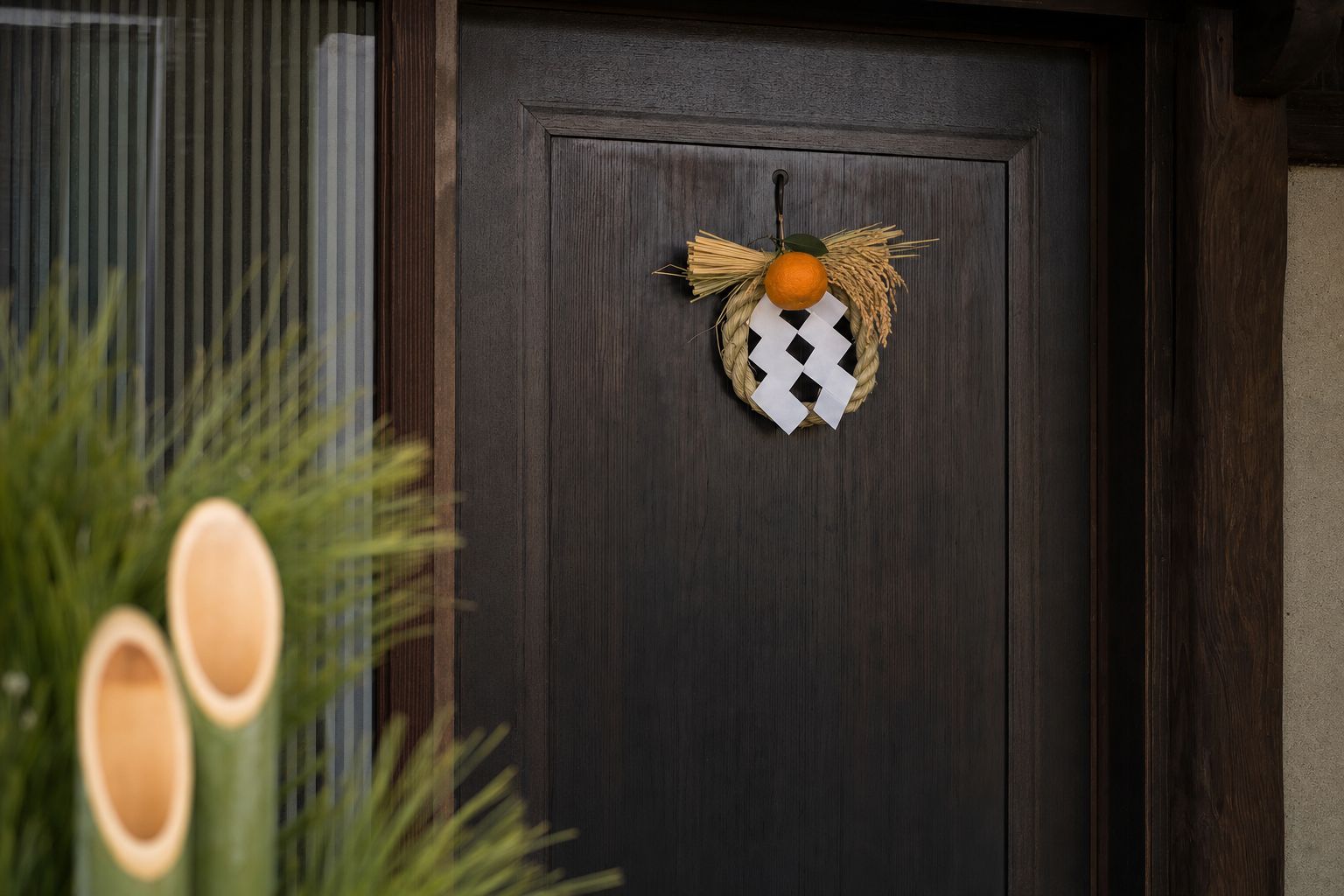
Walk through a Tokyo neighborhood in the last week of December and you’ll see the same three things appear within a few days of each other: pine-and-bamboo arrangements flanking entrances, straw ropes with a folded paper zigzag hung on front doors, and, indoors, small stacked discs sitting on a shelf. Most English coverage of “Japanese New Year decorations” treats this as one tradition. It’s three separate objects with three separate jobs, and once you know which is which, the whole thing stops looking like decoration for its own sake.
The short answer: kadomatsu stands outside the entrance as a temporary perch for the New Year deity, shimekazari hangs on the door as a protective marker, and kagamimochi sits indoors as an offering to that same deity — and all three have a specific window to go up, a specific window to come down, and a couple of dates you’re not supposed to touch them at all. None of it is complicated once it’s laid out. Almost none of the English-language coverage lays it out.
Kadomatsu: the one standing guard outside
A kadomatsu is an arrangement of pine branches and cut bamboo stalks, usually three stalks sliced at a diagonal angle so the cut end shows the hollow rings inside, bundled with straw rope at the base. The name is a literal pun: matsu is both the word for pine and the word for “to wait,” so a kadomatsu at the gate is, depending on how literally you want to take it, either a pine tree by the door or a sign that the house is waiting for something. What it’s waiting for is toshigami, the New Year deity, who’s said to use the arrangement as a temporary resting place on the way into the home.
Size varies more than any single photo suggests. The ones you see flanking a hotel lobby or a department store entrance are genuinely large, built for a façade rather than a front door, and businesses often commission a matched pair from a florist. A household version is much smaller, and the ¥100-shop and home-center versions sold for an apartment door are smaller still — closer to a tabletop arrangement than a landscaping feature.
Shimekazari: the one on the door itself
A shimekazari is shorter and simpler than it looks in photos — a twisted straw rope related to the shimenawa ropes you’ll see marking off sacred space at a shrine, dressed with a zigzag-folded white paper strip called shide, usually finished with a small citrus fruit or a cluster of fern leaves. Where a shimenawa marks off a whole sacred boundary, a shimekazari is scaled down to do the same job for one household: it goes on the front door, and its purpose is part welcome mat for the visiting deity, part purification marker telling bad luck it isn’t invited in.
This is the one I actually notice most, because it’s the cheapest and the most apartment-friendly of the three. A supermarket or home center will stock a basic one for a few hundred yen; a nicer version runs higher. Loft’s 2025 New Year lineup, for example, had a small rice-straw piece built on a shimekazari with the zodiac animal added, at ¥1,650. It’s also the decoration most Japandi moodboards could actually use without modification — small, wall-mountable, made of natural material, gone again in a couple of weeks.
Kagamimochi: the one that stays inside
Kagamimochi is an offering to the New Year deity: two round mochi discs stacked one on top of the other, smaller on top of larger, usually topped with a daidai — a bitter orange that’s inedible on its own but earns its spot through a pun: daidai is a near-homophone of 代々, meaning “generation after generation,” so the orange on top is a wish for the household to continue that way. The stack itself is said to resemble an old bronze mirror, which is where the name comes from — kagami means mirror — and the two discs are usually explained as the sun and the moon, or yin and yang, stacked as a wish to pile up another good year.
It goes indoors, often on whatever shelf or alcove is the household’s version of a small display space. A real washitsu usually has a tokonoma alcove built for exactly this kind of seasonal object; most apartments don’t, so it ends up on a sideboard or a kitchen shelf instead, which does the job fine.
Here’s the honest flaw nobody puts on the box: a pair of real rice-mochi discs sitting out at room temperature for two weeks grows mold, reliably, which is exactly why most households buying for a modern apartment now use a plastic shell shaped like the stack, with individually wrapped mochi sealed inside for eating later at kagami biraki. It’s less photogenic than the real thing. It’s also why the plastic version has become the normal choice rather than a compromise — nobody’s actually nostalgic for scraping mold off a decoration.
The days you’re not supposed to decorate
This is the part every guide to kadomatsu and shimekazari mentions once and then drops, and it’s the single most useful piece of the whole tradition: there are two dates you’re not supposed to put these up.
December 29 is out because the number 29 can be read with a sound tied to ku, as in kurushimu — suffering — giving the date a “double suffering” reading nobody wants attached to a New Year’s wish. December 31 is out for a completely different reason: putting decorations up on the last possible night is called ichiya-kazari, “one-night decoration,” and it’s considered a halfhearted, last-minute gesture rather than a proper welcome. The one-night timing also echoes funeral preparations, which nobody wants on New Year’s Eve. Traditional practice starts as early as December 13, but most households today wait until after Christmas and finish by December 28 or 30 — whichever date avoids the 29th without sliding into the 31st.
Nobody is going to fine you for getting this wrong. It’s a cultural preference, not a law. It’s also one of those details that’s easy to just build into a calendar reminder if you want the version of the tradition that actually lines up with when Japanese households are doing it.
Taking them down is its own calendar
The period a kadomatsu and shimekazari are supposed to stay up is called matsu no uchi, and — this is a genuine regional split, not a rounding error — it ends on January 7 in the Kanto region and January 15 in Kansai. My own household straddles that line: I grew up in Gunma, on the Kanto side, and my wife’s family is from the Kyoto side, so between the two of us there are two different “right” days circled on two different calendars for the same decorations.
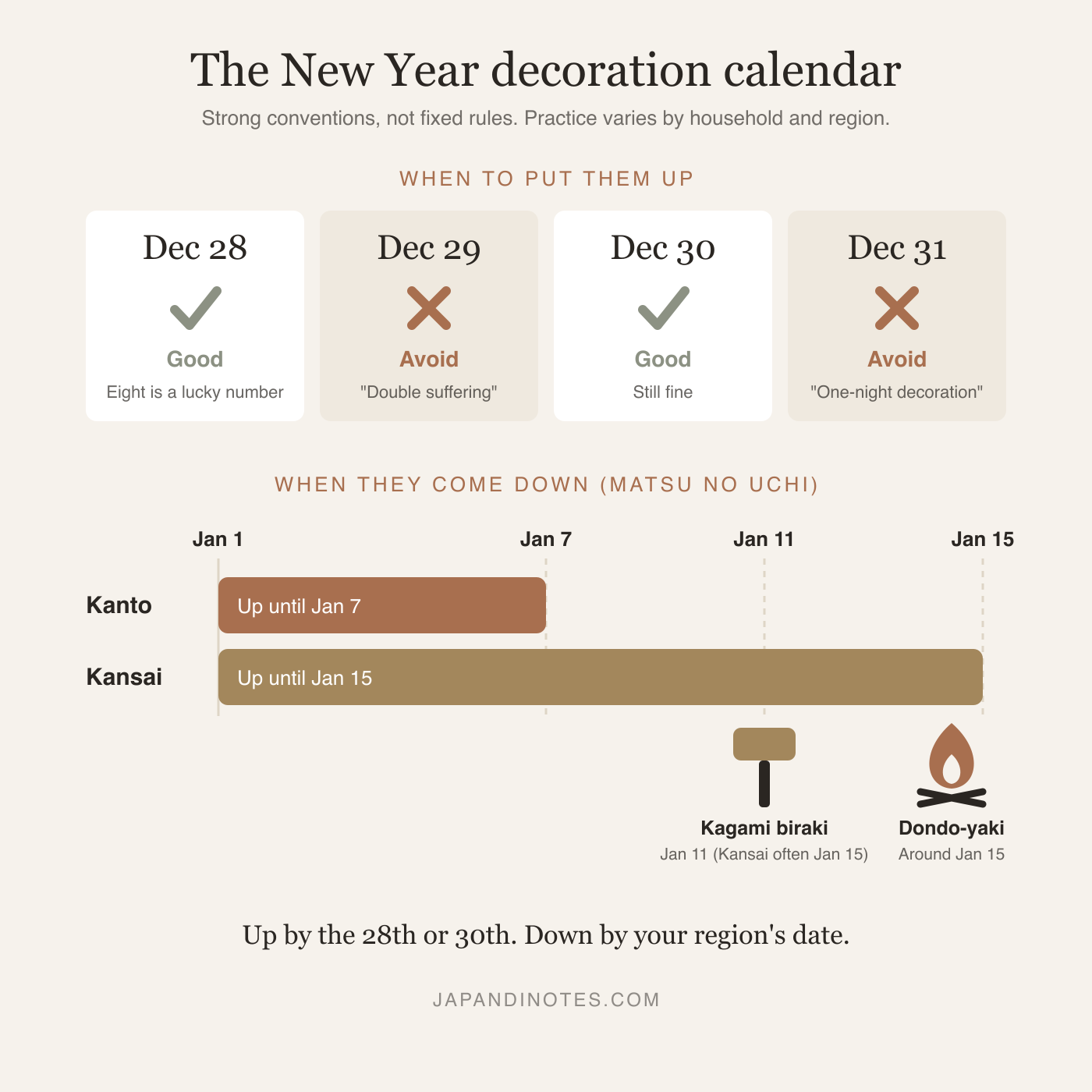
What happens to them afterward isn’t the trash can. The traditional disposal is dondo-yaki, a bonfire — sometimes called sagicho — held at a shrine or an open field around mid-January, where households bring their kadomatsu, shimekazari, and shimenawa to be burned together rather than thrown out with regular garbage. People often roast mochi over the embers while they’re there, which is about as far from “taking down the decorations” as a chore gets.
Kagamimochi runs on its own separate date: kagami biraki, usually January 11 in Kanto and often January 15 in Kansai, when the now rock-hard mochi gets broken apart and eaten, typically in soup or toasted. The one hard rule here is that nobody cuts it with a knife. The mochi gets broken by hand or with a wooden mallet instead — the explanations for why vary by source, from the word “cut” carrying bad associations to an older link with ritual sword use, but every version agrees on the method. You open it. You don’t cut it.
What’s actually worth copying at Japandi scale
Skip the full-size bamboo-and-pine kadomatsu entirely unless you’re decorating an actual storefront. It’s built for a façade, it needs a proper doorway width most apartments don’t have, and the version sized for that job looks wrong shrunk down to fit beside a regular front door — the proportions that read as “grand entrance” at hotel-lobby scale read as “oversized houseplant” at home scale.
The shimekazari is the one that actually belongs on a normal front door, and it needs almost no adaptation: a small straw or dried-flower wreath with one piece of citrus or a cluster of dried leaves does the job, costs very little, and comes down again in a couple of weeks so it never turns into permanent front-door clutter. For the mochi, buy the plastic reusable shell rather than the real discs — it’s not cheating, it’s what most Japanese households buying for a small apartment already do, and it skips the mold problem entirely.
Where to store the extra pieces for the other 50 weeks of the year is the same oshiire logic that already runs the rest of a Japanese closet: seasonal objects get boxed up out of sight rather than displayed year-round, which is half of why they still feel like an event when they come back out.
Where I’m honestly still filling this in
I notice these three things mostly the way any Tokyo apartment-dweller does — on the walk to the station, outside the office building, at the convenience store register — rather than from a big household ritual of my own. My wife’s family is from Tango, on the Kyoto side, and I haven’t sat down and asked her how her household runs kagami biraki, so I’m not going to invent a scene I haven’t actually seen just to make this section read more personal. The same gap shows up in the tatami room piece on this site, for the same reason.
What I can tell you without guessing: the calendar is real, the regional split between Kanto and Kansai is real, and the three objects really are doing three different jobs even though they all show up in the same two-week window every year.
— Sen
The dates and prices above come from a mix of retailer listings and cultural guides rather than one official source, and practice varies by household and region — treat the exact days as a strong convention rather than a fixed rule.

From our print shop
Wall art, made with this palette
Two collections built on the exact five colors from this site — watercolor landscapes and sumi-e botanicals. Instant download, five print sizes per artwork.
See all the prints →The 5 Japandi Principles (Free Cheat Sheet)
The five ideas that actually transfer from real Japanese homes — printable, one page, free.
Get the cheat sheet →